
If you are comparing a hassock vs ottoman, the main difference comes down to design and function. A hassock typically denotes a plain, cushy upholstered footstool or low seat, whereas an ottoman may have more design choices, such as storage, larger seating areas, ornamental bases, and multi-purpose applications. The terms hassock vs ottoman are often used interchangeably in modern furniture, so you should select according to your space, material, comfort, durability, and project needs rather than the name alone.
In the case of villas, hotels, apartments, offices, and other large projects, you need to go beyond the surface. The final choice can depend on the quality of the materials, the construction of the frame, the upholstery performance, fire-safety considerations, size, durability, customization, production lead time, and overall procurement cost.
At George Group, we assist our clients in comparing these details, matching furniture with project drawings, creating custom designs, and arranging bulk sourcing of furniture under one roof.
1. What Is a Hassock vs Ottoman?
A hassock typically refers to a low and padded item of furniture that can be used as a footrest, additional seat, or small accent furniture. Most hassocks are plain-shaped with no storage and soft upholstery.
An ottoman also works as a footrest or seat, but the category covers a wider range of designs. An ottoman may have storage, a firm top, ornamental legs, a wooden frame, or a more spacious surface that serves as a coffee-table substitute.
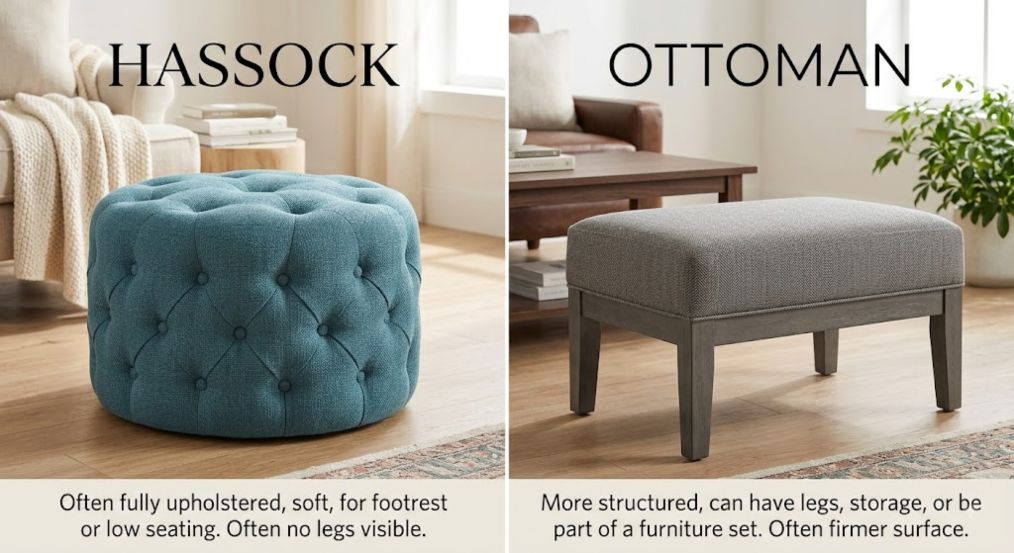
The simplest method of seeing the difference between a hassock vs ottoman is as follows:
- The hassock tends to be more concerned with simple and soft and low profile comfort, whereas the ottoman provides more options in size, shape, storage, and use.
These terms are not, however, always used in the same sense by furniture manufacturers and retailers. A padded footstool can be referred to as a hassock by one manufacturer and an ottoman by another.
So, when purchasing hassock vs ottoman furniture for a project, never use the product name as your only guide. Always look at the actual specifications.
2. Hassock vs Ottoman: What Is the Difference?
The ottoman vs hassock comparison becomes easier when you look at function, construction, and design flexibility.
| Feature | Hassock | Ottoman |
| Main Function | Footrest or occasional seat | Footrest, seat, storage, or table |
| Typical Design | Simple and compact | Wider range of designs |
| Storage | Usually uncommon | Common in some designs |
| Shape | Often square or round | Square, rectangular, round, oval, or custom |
| Upholstery | Usually soft and padded | Fabric, leather, faux leather, velvet, and other options |
| Customization | Available | Widely available |
| Commercial Use | Suitable for selected applications | Suitable for many commercial applications |
| Best Advantage | Simple comfort | Versatility |
The difference becomes more important when you are buying furniture for a large project.
An instance is when a homeowner selects a small round hassock due to its appearance next to an armchair. A hotel developer might select a custom ottoman in a rectangular shape using a hard-wearing commercial-grade fabric since it must be used as a seating area in a hectic guest lounge.
Is a Hassock the Same as an Ottoman?
No, but the words are similar.
Both products may serve to give your feet a rest or sit temporarily. Padded upholstery can be used in both. They can both be used in the living room, bedrooms, hotels, offices and lounges.
The largest variation is due to design flexibility and intended use.
A hassock can be just the thing you need in order to have a simple upholstered footrest. An ottoman could provide more choices, should you require storage, more seating, a coffee-table feature, or a custom piece of furniture that fits a whole interior.
3. Hassock vs Ottoman for Residential Spaces
In residential projects, you will be able to pay more attention to comfort, appearance, room size, and personal style.
Living Rooms
A hassock is a good companion to an armchair or a sofa when a comfortable footrest is mostly required.
An ottoman offers you greater choices. You can use it as:
- A footrest
- Extra seating
- A small coffee table
- A decorative centerpiece
- A storage unit
- A shelf on which to show books or accessories.
As an example, consider a big villa with a sectional couch in the living room. The open space in front of the sofa can be filled with a large rectangular ottoman that could be used as an additional seating space when guests come.
A smaller hassock can be a better choice in a smaller apartment, as it occupies less space both visually and physically.
Bedrooms
An ottoman can be put at the end of a bed to provide a comfortable place to sit.
A storage ottoman can also provide you with additional storage space (blankets, pillows, etc.).
A hassock may serve in case you require a little bench close to a dressing table or reading chair.
Villas and Large Homes
Big villas tend to have furniture that has a particular size. A typical retail ottoman might not fit the room appropriately.
You may need:
- A specific length and width.
- Matching upholstery
- Custom height
- A specific wood finish.
- A particular style of leg.
- Matching sofas and chairs
- Custom colors
- An integrated furniture set.
Custom hassocks and ottomans give you more control over the final interior in this situation.
4. Hassock vs Ottoman for Commercial Spaces
Commercial projects should be approached in a different way.
Traffic, cleaning, durability, safety, maintenance, appearance, and replacement costs must be considered.
A piece of furniture that is ideal in a personal bedroom might not be effective in a hotel lobby.
Hotels and Hospitality Projects
Ottomans and hassocks are commonly used in hotels:
- Hotel rooms
- Lobbies
- Executive lounges
- Waiting areas
- Restaurants
- Suites
- Meeting spaces
In the case of hospitality projects, select upholstery that is capable of being used regularly and cleaned.
An example is that a luxury hotel can opt to use a large upholstered ottoman with high-quality fabric to give it a high-end appearance. Instead, a business hotel can focus on easy cleaning and stain resistance.
You should also match the ottoman with the hotel’s other furniture. The colors, materials, wood finishes, and metal details can be matched to make a more complete design.
Modern Offices
Flexible furniture is becoming a common feature in modern offices rather than lines of conventional desks and chairs.
Ottomans can support:
- Informal meetings
- Breakout areas
- Reception spaces
- Lounge seating
- Collaborative work zones
The layout can be changed swiftly by a lightweight ottoman that can enable employees to swap the layout.
Ottomans may also be used together with the sofas, lounge chairs, acoustic furniture, and movable partitions to make various work areas.
Apartments and Residential Developments
In the case of apartment developments, the primary issue is usually the cost management and uniformity.
You should not consider just the cost of a single ottoman in case you require hundreds of pieces of furniture.
Rather, estimate the overall project cost, including:
- Product price
- Customization
- Packaging
- Quality inspection
- Shipping
- Import costs
- Storage
- Replacement requirements
- Delivery schedule
A slightly higher-quality product may reduce replacement and maintenance costs over time.
Hospitals and Nursing Homes
Healthcare settings require additional concern on hygiene, safety, stability and cleaning.
When choosing hassock vs ottoman furniture for these projects, consider:
- Easy-clean upholstery
- Durable surfaces
- Stable construction
- Rounded edges
- Appropriate dimensions
- Low-maintenance materials
- Antibacterial finishes where project requirements dictate them.
You must also ensure that the furniture placement is clear to allow safe mobility of patients, visitors, wheelchairs, and staff.
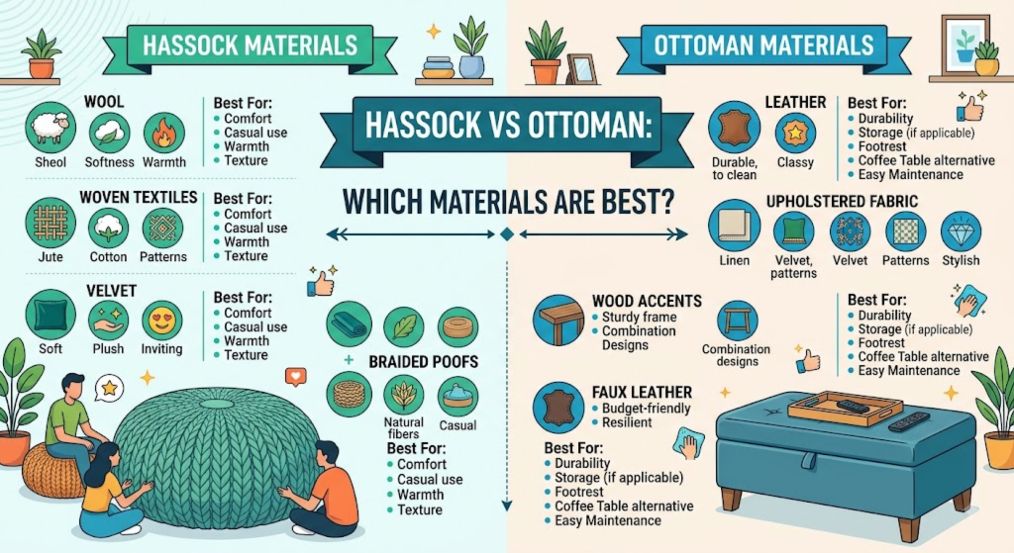
5. Hassock vs Ottoman: Which Materials Are Best?
The choice of material influences the look, comfort, durability and cost of the project.
Solid Wood and Engineered Wood Frames
A good internal frame assists the furniture in retaining its shape when it is in normal use.
Wood can be solid to offer strength and a high-end look. Engineered wood has the potential of providing uniform dimensions and economies of scale when the manufacturers choose the right grade and construction technique.
In the case of large projects, inquire with the manufacturer about:
- Frame material
- Joint construction
- Reinforcement
- Moisture considerations
- Expected use
- Quality-control procedures
Upholstery Materials
There are numerous upholstery materials you can select:
- Leather
- Faux leather
- Velvet
- Linen
- Polyester fabrics
- Performance fabrics
- Commercial-grade upholstery fabrics
When comparing upholstery fabrics for commercial use, look beyond appearance and ask for documented performance characteristics. ASTM D4852 provides a practice for evaluating characteristics of attached upholstery fabrics and can help inform purchasing specifications between buyers and suppliers. ASTM D4852 — Evaluation of Attached Upholstery Fabrics
In the case of a private villa, you can afford to focus on looks and coziness.
In the case of a hotel lobby, you can put more emphasis on abrasion resistance, stain resistance, cleanability, and durability.
Foam and Cushion Materials
Foam influences service life and comfort.
Poor foam may easily lose its shape with frequent use. Depending on the full-furniture construction and usage conditions, high-density foam can offer better support and be able to retain its shape longer.
In commercial work, insist on the foam specifications of the manufacturer, rather than a general statement like high-quality foam.
6. Commercial-Grade Hassocks and Ottomans: What Specifications Matter?
When you buy furniture in a commercial project, consider the product as a technical specification and not as a decorative product only.
Important factors include:
- Load Capacity: Check the desired seating weight load.
- Frame Construction: Inquire about the materials and reinforcement that the manufacturer employs.
- Foam Specification: Select foam type and density where comfort and long-term performance are important.
- Abrasion Resistance: Commercial furniture can be subjected to a lot more use than residential furniture.
- Stain Resistance: This may save time in cleaning the hotel, restaurant, office and medical facilities.
- Moisture Resistance: Choose the appropriate materials when the project environment exposes the project to greater moisture.
- Fire Performance: There are commercial and hospitality projects that demand certain fire-performance features of upholstered furniture. Never start production without checking what is needed in the project location and type of building.
- Antibacterial Finishes: Healthcare and high-contact environments might need more hygiene-oriented materials or finishes.
- Dimensions: Before production, verify completed dimensions, tolerances, seat height and clearance requirements.
An effective procurement process begins with a specification sheet.
7. Fire Resistance, Durability, and Furniture Standards
Furniture standards vary depending on the country, product type, materials, and building use.
As an example, U.S. projects may have specific upholstered-furniture flammability requirements. The U.S. Consumer Product Safety Commission (CPSC) explains the federal requirements for upholstered furniture and the connection with California Technical Bulletin 117-2013 (TB117-2013). CPSC Upholstered Furniture Flammability Requirements
Other international projects might set standards, including BS 5852 of the ignitability of combinations of seating materials upholstered. Nevertheless, you must not think that a single test or certificate will always meet the requirements of every country.
For UK projects, you should also check the applicable Furniture and Furnishings (Fire) (Safety) Regulations, which cover flammability requirements for upholstery cover and filling materials. UL Solutions — UK Furniture and Furnishings Fire Safety Regulations
In case of commercial procurement, request your supplier to provide you with the following:
- Test reports
- Material specifications
- Fire-performance documentation
- Fabric specifications
- Foam specifications
- Quality-control records
- Certification documents
For upholstery fabrics, relevant ASTM testing can help buyers evaluate properties such as surface abrasion, tear strength, colorfastness, and flammability. ASTM D3597 Upholstery Fabric Performance Specification
Another thing that you should do is to ensure that the requirement is the exact requirement with the architect, consultant, authority, or specification documents of the project.
8. How to Choose Between a Hassock vs Ottoman for Your Project
You can make the decision more easily by starting with the intended use.
Choose a Hassock If You Need:
- A simple footrest
- Compact furniture
- Soft seating
- A minimalist appearance
- An occasional seat
- A reduced footprint of furniture.
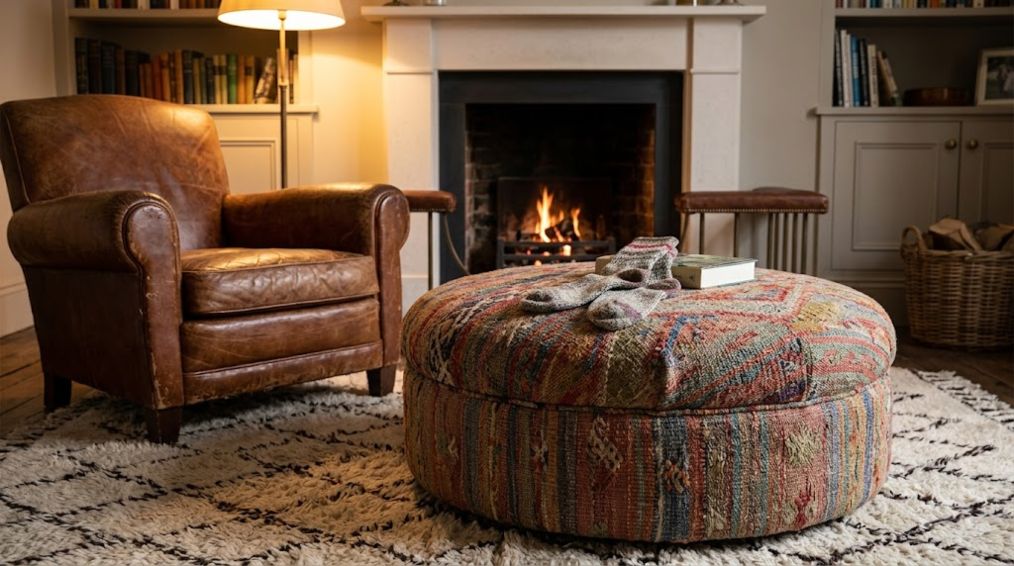
Choose an Ottoman If You Need:
- Extra seating
- Storage
- A larger surface
- A coffee-table alternative
- A decorative centerpiece
- More customization
- An item of furniture that serves more than one purpose.
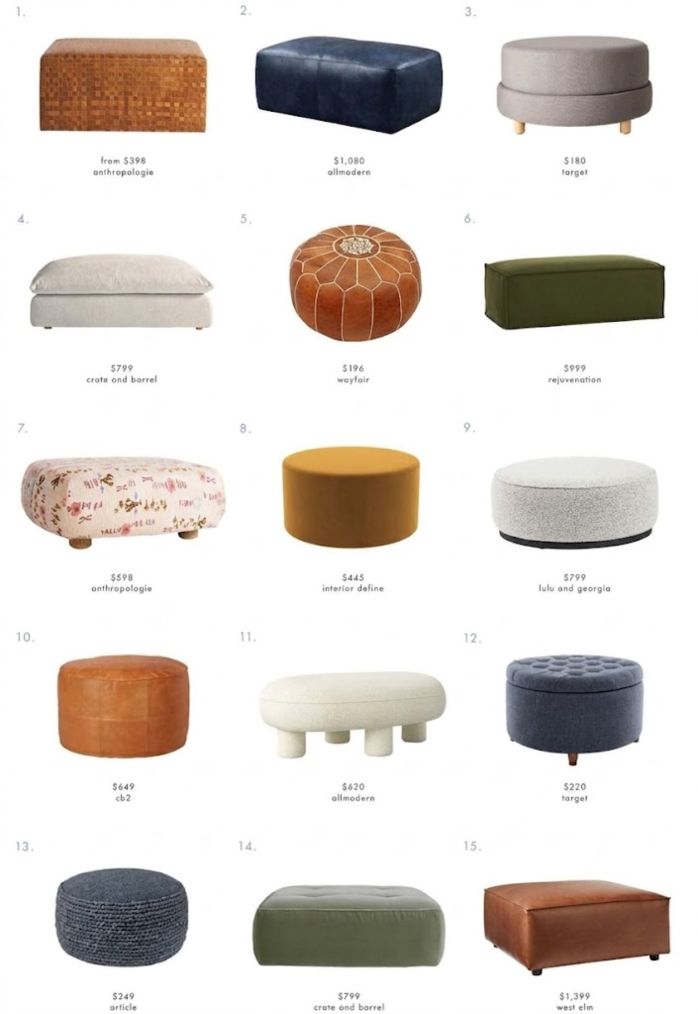
Choose Custom Furniture for Large Projects If:
- Your furniture needs to follow non-standard dimensions.
- You require similar furniture.
- You have fixed room dimensions.
- You require certain upholstery.
- You require integrated colors and finishes.
- You need hundreds of similar or matching pieces.
- You want to control the overall project budget.
9. Custom Hassocks and Ottomans for Villas, Hotels, and Commercial Projects
Big projects may require something bigger than a catalog product.
Suppose that you have a room design in your hotel and need an ottoman that is 1,400 mm wide, a certain fabric, wooden base, and cushion thickness. A typical retail product might not be similar to your drawings.
A custom manufacturer is able to make the furniture as per your approved specifications.
You can customize:
- Length
- Width
- Height
- Shape
- Frame material
- Upholstery
- Foam
- Base
- Legs
- Color
- Finish
- Stitching
- Branding details
This practice can assist designers and architects to uphold a uniform appearance in the project.
10. How George Group Supports Custom Furniture Design
We do not just support our clients in sourcing products at George Group. We assist in linking project design, product selection, customization, production, and supply chain planning.
2D Layout Matching
Our design team will be able to look over project drawings and assist in aligning furniture sizes and available space.
This measure can assist you to detect issues prior to production.
To illustrate, when an ottoman occupies an unsuitable amount of space around a sofa, we can change its size during the design phase and not after it has been manufactured.
3D Rendering Design
Our team can also create 3D renderings to show how the selected furniture will look in the proposed interior.
You can review:
- Furniture size
- Fabric color
- Material combinations
- Furniture placement
- Overall visual balance
- Matching pieces
This helps you visualize the final result before approving production.
Sample Production Before Bulk Orders
In the case of large projects, we suggest that samples be checked prior to making the entire production order.
You can review the:
- Fabric
- Color
- Stitching
- Foam
- Frame
- Finish
- Dimensions
- Overall workmanship
After you approve the sample, our team can use the approved specifications as the production reference.
11. Hassock vs Ottoman: China Sourcing vs Local Purchasing
When sourcing furniture for a large-scale project, you may need to compare local and Chinese suppliers.
In certain markets, local purchasing may have shorter delivery distances and simpler communication.
Sourcing from China can offer advantages such as greater manufacturing capacity, customization options, material choices, factory selection, and competitive bulk pricing.
However, you should compare the total landed cost rather than the factory price alone.
You should calculate:
- Project cost = factory price + customization + packaging + inspection + shipping + import costs + local delivery.
For example, a $100 ottoman does not necessarily cost $100 when it reaches your project site.
At George Group, we assist our clients in the assessment of the entire procurement process in order to enable them to concentrate on cost management and reliability of the project.
12. How to Save Time and Money When Buying Hassocks and Ottomans from China
By planning in advance before production, you can save on unnecessary costs.
1. Finalize Dimensions Early
Provide correct drawings and room sizes prior to the production by the manufacturer.
2. Confirm Materials
State fabric, foam, frame, base, color, and finish.
3. Request Samples
Test the physical sample prior to bulk production approval.
4. Approve 2D and 3D Designs
Check proportions and appearance with the visual design support.
5. Consolidate Your Furniture Order
One-stop sourcing can make communication and logistics easier in case your project requires sofas, chairs, tables, beds, cabinets, and ottomans.
6. Plan Quality Control
Conduct inspection of products at the point of production and shipment.
7. Coordinate Shipping With the Project Schedule
Furniture should arrive when the project site is ready to receive it. Unnecessary storage and schedule issues can be avoided by planning early procurement.
13. Bulk Hassock and Ottoman Procurement for Large Projects
Bulk orders are more project-based than the purchase of a single piece of furniture.
Hotels, villas, apartments, offices, and healthcare projects can need hundreds or thousands of pieces of furniture.
In these orders, take note of:
- MOQ
- Production capacity
- Bulk pricing
- Production lead time
- Sample approval
- Quality control
- Packaging
- Container utilization
- Shipping schedule
- Replacement planning
- Installation guidance
We integrate design support, sample development, product sourcing, production coordination, quality control, logistics, and installation guidance to form a streamlined procurement process at George Group.
We can also coordinate different types of furniture, so you do not have to deal with multiple suppliers individually.
14. What to Ask a Hassock or Ottoman Manufacturer Before Ordering
The questions to ask before you place a large order are
- What type of frame material do you use?
- Which foam specification do you offer?
- What fabric options do you offer?
- Are you able to offer commercial-grade fabrics?
- What information can you provide about abrasion resistance?
- Can you provide fire-performance documentation when required?
- What is the suggested load capacity?
- Is it possible to tailor the dimensions?
- Are you able to match project drawings?
- Do you offer 3D or 2D design services?
- Are you able to generate a pre-production sample?
- What is the MOQ?
- What is the lead time of production?
- What do you do to manage quality?
- What is your process for shipping furniture overseas?
- Do you have the option of shipping multiple furniture items in a single shipment?
These questions enable you to compare suppliers on the basis of real project needs, rather than the photos of the products and unit prices.
15. Hassock vs Ottoman: Which Is Better for Your Project?
There is no single winner in the hassock vs ottoman debate.
A hassock is a good choice when you require a straightforward, comfy, low-profile footrest or an occasional seat.
An ottoman is more practical when you need additional features such as storage, extra seating, a larger surface, or a customized design.
In residential areas, emphasize comfort, style, size, and functionality.
In the case of commercial spaces, consider durability, cleanability, material performance, safety, maintenance, and lifecycle cost.
In the case of hotels, villas, apartments, and large developments, custom furniture may offer more effective control over the dimensions, materials, finishes, and overall design uniformity.
The best option depends on what you need the furniture to do and how often it will be used.
16. Choose the Right Hassock vs Ottoman With George Group
Choosing the right furniture starts with your project needs, not the product name. Comparing a hassock vs ottoman, keep in mind its functionality, size, materials, durability, safety, customization, certification, delivery time, and overall price.
At George Group, we help architects, designers, developers, engineers, contractors, and homeowners source furniture through a one-stop process. We can provide 2D layout matching, 3D rendering, sample production, customized manufacturing, quality control, bulk procurement, logistics coordination, and installation guidance.
Provide us with project drawings or furniture needs. We will assist you in examining the appropriate design, materials, size, and method of procurement of your project and create a viable solution that will save time and money.
- Need help choosing the right hassock vs ottoman for your project? Contact George Group today to discuss your requirements and find the right furniture solution for your space.
FAQs About Hassock vs Ottoman
What is a hassock vs ottoman?
A hassock is a simple, padded footrest or a seat, typically low. An ottoman encompasses a wider scope of furniture designs and can be used to offer seating, foot support, storage, or table-like capabilities.
Is a hassock the same as an ottoman?
No. The terms are used interchangeably, though more design and functional options are usually provided in an ottoman. The two terms might be used to refer to similar products by some manufacturers.
Which is better, a hassock vs ottoman?
Neither option is better for every situation. Choose a hassock for simple foot support and occasional seating. Select an ottoman when you require storage, additional seating, a bigger surface, or greater personalization.
Can an ottoman be used as a chair?
Yes, there are lots of ottomans that can be used as occasional seating. Before using an ottoman as a normal chair, however, you must ensure that you check the manufacturer’s load capacity, construction, height, and purpose of use.
Are hassocks suitable for commercial spaces?
Yes. Hassocks may be used in hotels, offices, lounges, apartments, and other commercial spaces provided that their materials and constructions are suitable to the use needs of the project.
Can ottomans have storage?
Yes. There are numerous ottomans with a hinged or removable top to form internal storage. Storage ottomans will be particularly effective in bedrooms, living rooms, hotel suites, and apartments.
What materials work best for commercial ottomans?
Commercial ottomans can use solid wood or engineered wood frames, high-quality foam, leather, faux leather, performance fabrics, and other durable upholstery materials. The optimal mix is based on traffic, cleaning needs, design, and budget.
Do commercial ottomans need fire-safety compliance?
Certain projects demand definite fire-performance properties of upholstered furniture. The requirements are based on the country, type of building, materials, and project specifications. Always ensure that the requirements are checked prior to production.
Can hassocks and ottomans be custom-made?
Yes. Manufacturers are able to tailor the size, shape, upholstery, foam, frames, base, colors, finishes, and other specifications. Tailor-made production is especially efficient with villas, hotels, apartments, offices, and large commercial projects.
Is it cheaper to buy custom ottomans from China?
China can offer competitive pricing and a wide range of customization options, particularly for large orders. However, you should compare the total landed cost, including manufacturing, inspection, shipping, import costs, and local delivery.
How long does it take to manufacture custom ottomans?
The lead time varies based on the design, materials, quantity, approval of the sample, factory schedule, and mode of shipping. Big projects must complete specifications and samples early to allow production to keep pace with the entire construction process.